I'm starting a series of blogs on neural networks. We'll deep-dive into the core concepts, and we'll write everything from scratch.
You might be thinking: LLMs are so popular today, so why do we even need this? Here's the thing. LLMs did not appear out of nowhere. They're the result of a long chain of ideas, and neural networks, along with all the concepts that come with them, are a big part of that chain. So if you want to understand how an LLM actually works, you first have to go back a little and make sure you understand the pieces it's built on.
The reason I'm writing this isn't only that I want people to understand how neural networks work. It's also a bit selfish: writing this will solidify my own understanding. There's a saying that if you can teach a concept well, then you truly know it. Putting these ideas into words is the fastest way for me to find the spots where my own understanding is still shaky.
There are already a ton of resources out there, videos, blogs, and articles, and some of them are genuinely excellent. I'm not claiming mine will be better. What I am going to try to do is demystify the parts that those resources left unclear for me, share the things I had to figure out on my own because no single resource explained them, and pull all of it together in one place. I'll try to keep things simple while still going deep on every concept, so that ideally you don't have to jump between ten other tabs and end up more confused than when you started.
One heads-up before we begin: a few of these concepts are genuinely hard, and you probably won't understand them on the first read. That's completely normal. My recommendation is to read the article again and give yourself some time to sit with the idea. The researchers who came up with these things spent years on them, so it's unrealistic to expect to absorb everything in one go. We all learn at different speeds. Be patient with yourself.
Here's the rough order of what we'll cover. I'll keep this updated as the series takes shape.
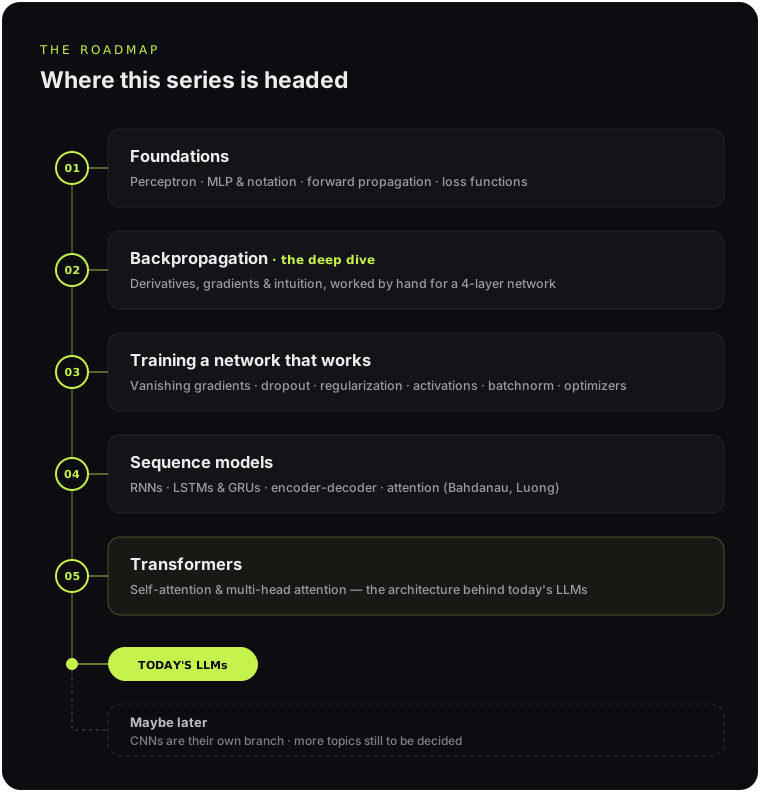
The foundations
- The perceptron: what it is, the perceptron trick, and where it falls short
- The multi-layer perceptron, and the notation we'll use throughout
- Forward propagation
- Loss functions
Backpropagation (the part we'll slow down for)
This is where we go deep and work through the derivatives for a four-layer network by hand. Along the way:
- What a derivative actually is, and how it helps us minimize the loss
- What a gradient is
- The intuition behind backpropagation (and stochastic gradient descent)
- Convergence, and how an MLP reuses its forward-pass values during backprop (memoization)
Training a network that actually works
- Vanishing gradients
- Gradient descent and its variants (batch, stochastic, and mini-batch)
- How to improve the performance of a network
- Overfitting
- Dropout
- Regularization (L1 and L2)
- Activation functions
- Weight initialization techniques
- Batch normalization
- Optimizers (SGD, momentum, RMSProp, AdaDelta, AdaGrad, and Adam)
Sequence models
After that, we shift to recurrent architectures.
- RNNs, then LSTMs and GRUs
- Backpropagation through time
- Understanding the architectures: the how and the why
- The different types of RNNs
- Why plain RNNs struggle, and how LSTMs and GRUs fix it
- Deep RNNs, LSTMs, and GRUs
- Bidirectional RNNs, LSTMs, and GRUs
I'm hoping to write the code for these by hand too, though I haven't decided yet whether that's necessary.
Toward transformers
- Encoder-decoder models
- Attention (Bahdanau and Luong)
That's roughly as far as I've mapped out in detail so far. After attention, we'll get into transformers, including self-attention and multi-head attention, which make up the architecture behind today's LLMs. I'm still undecided on CNNs, since they're really their own branch of the field, and there's more I'll figure out as we go.
A couple of things I'll do in every post:
- Link the resources that actually helped me when I was learning the topic.
- Go beyond theory. We'll implement every concept in code.
Last thing, on how this is written. I use Claude to check my grammar and to make sure I'm explaining things the way I intend to. So some of what you read is AI-assisted, but the ideas and the original words are mine. The AI only helps me say them more clearly.
That's the plan. Let's get into it.